
Built for the practice as it is, not as software imagines it.
Lexli is a workspace for Indian legal practice, organised by case, connected to the courts, and built by a small team in Nagpur.
Why Lexli exists
Most of the day is
not the practice of law.
An advocate's day contains a great deal of work that is not the practice of law. Checking tomorrow's board across three sites. Typing the same party names into the fourth application this month. Finding the order copy that exists in four places and is current in none.
None of it requires judgement. All of it costs the hours where judgement happens.
Lexli exists to take that layer off the desk, and to leave everything that genuinely requires an advocate exactly where it is.
Behind that are two larger reasons.
Paper
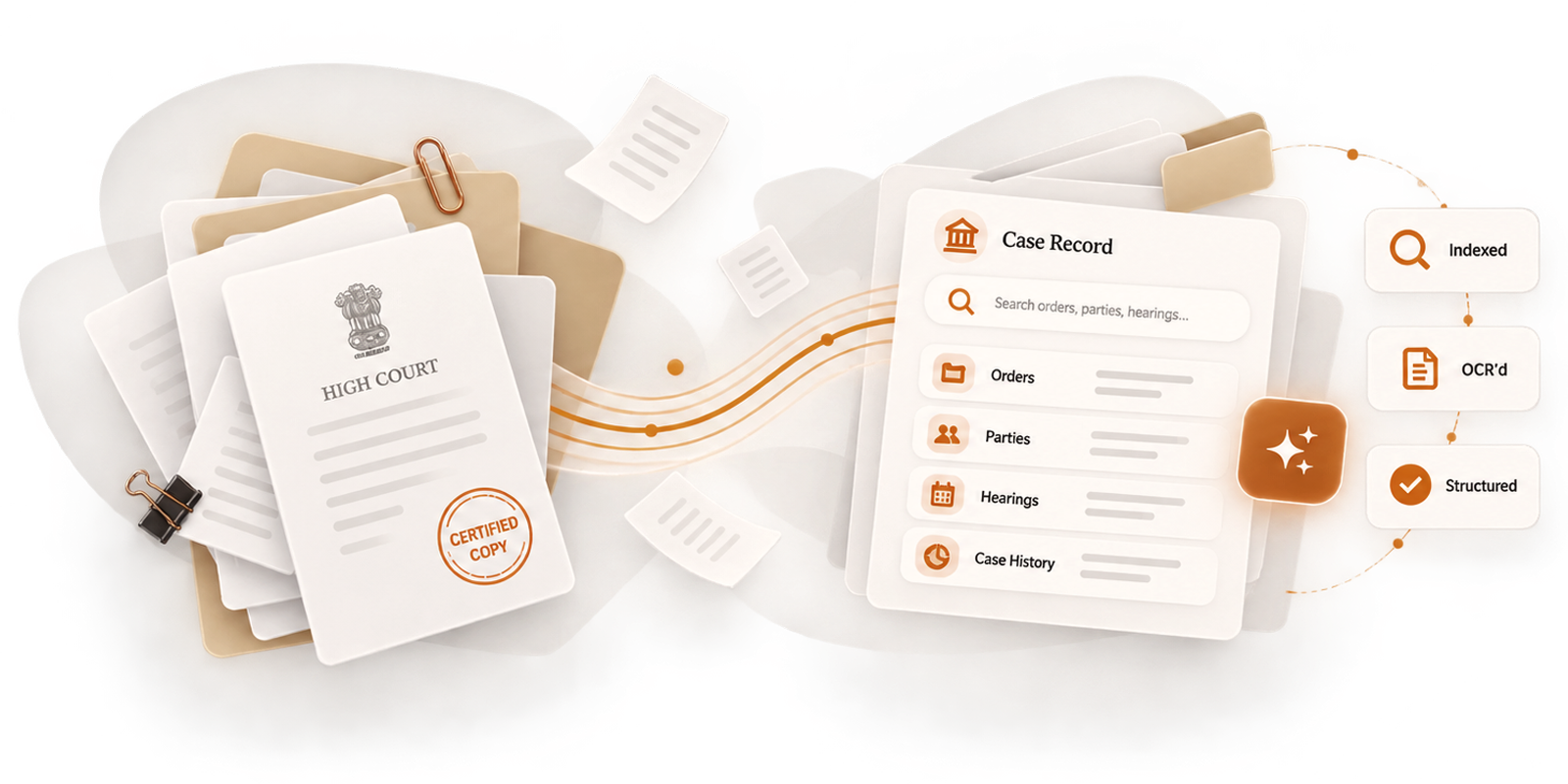
Most of a practice still lives in physical files, and every file that exists only on paper has to be found, copied, carried, and retyped. Lexli is built so the case record can be digital from the day the case opens, without the practice giving up anything it relies on.
Access
Most people who need the law cannot easily reach it. A litigant with one case and no idea where it stands. A clerk with a question and no one free to answer it. Lexli is built so the answer is easier to find, in the language they ask it, and easier to act on once found.
Lexli prepares. You decide.
Vision and mission
Legal intelligence, made accessible.

Vision
To be the name people in India associate with the law, and to power the future of the country's legal ecosystem through trusted legal intelligence.
Mission
To give advocates, legal professionals, businesses, and citizens accurate, multilingual legal intelligence they can act on, so the work is easier to do and the law easier to reach.
Why now
The record was already digital.
It just had nowhere to land.
Court records went online. Cause lists are published. Orders are digital before they are paper. The record an advocate needs is, increasingly, already in a machine, just scattered across a dozen of them, in formats built for publication rather than for work.
So Lexli gave it somewhere to land: the case record. Each tool exists somewhere as a separate product — what does not exist separately is the case they all share, and a point tool cannot copy that, because it does not have the record.
Integration is the moat a point solution can't copy.
Where Lexli stops
Two lines, drawn in public.
Every promise on this page rests on one thing: what happens when the platform acts. A values list is not verifiable, so here are two commitments that are.
We do not file on our own authority
Nothing leaves Lexli for a court, a client, or a portal without your explicit approval, through your own credentials. Preparation is ours; the act is always yours.
We do not replace the advocate's judgement
Every translation, draft, and packet comes back for review, with the original beside it and the doubtful passages flagged. Output is a starting point that expects to be checked.
Features will change. Coverage will grow.
These two lines do not move.
The team
A lawyer and two engineers.



Come and test the claim.
Create a free account and bring one case in, or talk to us about your practice.